Quartz Countertops Installation: Details That Influence the Finished Look
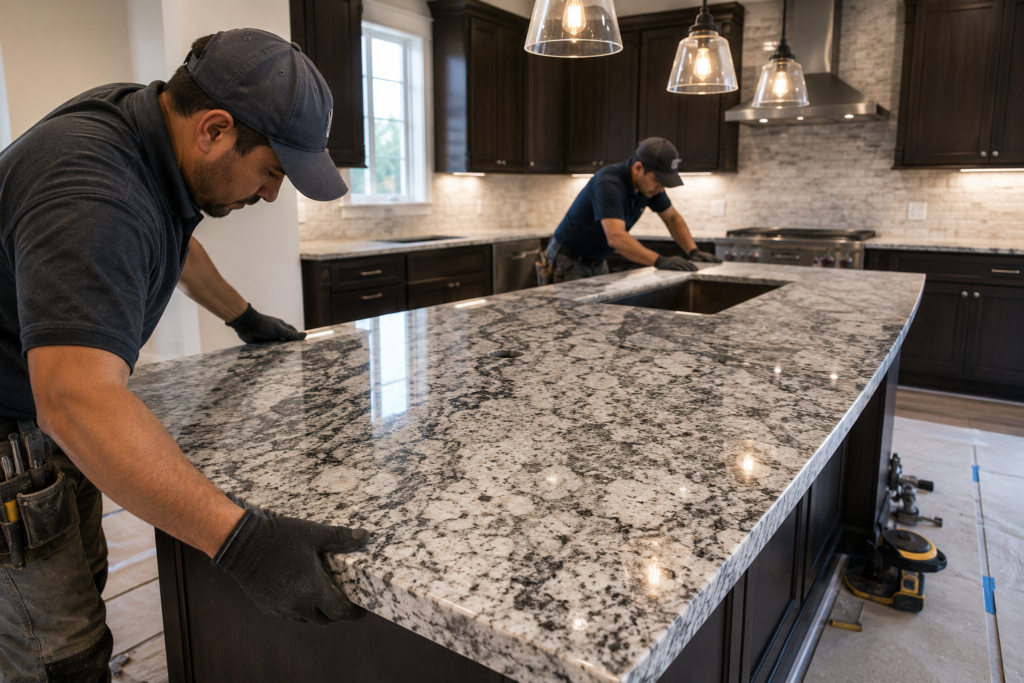
When people imagine a new countertop, they often focus on surface patterns, cabinet colours, flooring, and lighting. Yet many of the details that determine whether a countertop looks polished are established during quartz countertops installation. Alignment, seams, edges, overhangs, wall transitions, and fixture placement can all influence the visual quality of the finished room.
Understanding these details allows homeowners to evaluate a countertop as part of the entire interior rather than as an isolated surface.
Countertop Alignment Creates Visual Order
Kitchens contain numerous horizontal and vertical lines. Cabinet doors, drawers, appliance edges, backsplashes, and countertops all interact visually.
A properly fitted countertop should complement these lines.
Even minor alignment issues can become noticeable when viewed across a long run of cabinets. Precision during installation helps the room feel balanced and intentional.
Overhangs Should Look Consistent
Countertop overhangs affect both appearance and function. Consistent dimensions along cabinet runs contribute to a clean finish.
Seating areas may require different considerations from ordinary cabinet sections. These details should be established during planning rather than improvised during installation.
Seam Placement Deserves Attention
Large or complex layouts may require multiple quartz sections. When this happens, seam location becomes part of the visual design.
The goal is to position seams where they work appropriately with the layout while maintaining suitable installation conditions.
Professional quartz countertops installation considers both appearance and practical requirements instead of treating seams as an afterthought.
Homeowners interested in viewing surface options and discussing installation considerations can visit a local countertop design location before finalizing important project decisions.
Wall Conditions Affect the Final Transition
Few walls are perfectly straight. Small variations may not be obvious until a precisely fabricated countertop is installed beside them.
This is particularly relevant along long countertop runs.
Backsplash planning can help create a finished transition between the wall and countertop. Understanding these relationships early prevents unrealistic expectations about perfectly uniform wall gaps.
Corners Can Reveal Installation Quality
Corners bring several lines together and naturally attract attention. Proper fitting helps countertop edges meet the surrounding layout cleanly.
Complex kitchen shapes may require additional planning because corners are not always perfectly square.
Accurate measurements help installers account for these real-world conditions.
Sink Placement Changes the Visual Balance
The sink often acts as a focal point, particularly on long countertop runs or kitchen islands.
Its position should make sense both functionally and visually. The surrounding countertop needs sufficient usable space, while faucet placement must work with the sink configuration and nearby features.
Accurate fabrication is therefore an important component of quartz countertops installation.
Edge Details Shape the Overall Style
Countertop edges may seem like a small design choice, but they run throughout much of the room.
Consistent fabrication and fitting help these edges maintain a continuous appearance around corners and adjoining sections.
Edge alignment becomes particularly noticeable around islands, where multiple sides of the countertop remain visible.
Islands Need Special Consideration
Kitchen islands are often viewed from several directions, making installation details especially prominent.
Consider overhangs, seating, sink or cooktop placement, and alignment with surrounding cabinetry.
Because islands frequently become gathering spaces, practical comfort deserves as much attention as appearance.
Lighting Can Reveal Surface Details
Natural and artificial light changes how countertops appear throughout the day. Light can emphasize surface patterns, edges, seams, and reflections.
Viewing the completed countertop from several positions helps homeowners assess how it integrates with the entire kitchen.
Rather than judging only from directly above, step back and consider sightlines from adjoining rooms.
Function Should Support Appearance
A visually impressive countertop still needs to work comfortably. Appliance doors should open without interference, seating should feel practical, and work areas should provide adequate usable surface.
Good quartz countertops installation supports these everyday requirements while preserving the intended design.
The best results usually come when functional planning and visual decisions happen together.
Conclusion
Countertop installation is where design plans become physical details. Precise alignment, thoughtful seams, balanced overhangs, accurate openings, and carefully fitted edges can significantly influence how refined a kitchen feels.
Approaching quartz countertops installation with attention to these finishing details helps homeowners create a surface that does more than fill the space above the cabinets. It becomes an integrated part of the room, supporting both the visual design and the practical needs of everyday life.
About The Author