Solid Wood Furniture Care and Buying Guide for Lasting Pieces
A practical solid wood furniture care and buying guide: how to spot real solid wood, pick the right species, check joinery, and keep pieces stable for decades.

A well-made oak table can outlive the house it was bought for. The catch is that solid wood is a living material in one important sense: it keeps trading moisture with the air around it for as long as it exists. Good solid wood furniture care is mostly about respecting that, and good buying is about choosing pieces that were built by people who respected it first.
This guide covers both halves: how to spot a genuinely durable piece, and the habits that keep it looking right for decades.
What “solid wood” actually means on a product tag
Retail language is slippery. “Solid wood” should mean every visible part is cut from whole boards, but you will also see “wood construction,” “real wood veneer,” “hardwood finish” and “all-wood.” Those phrases can describe anything from a quality veneered panel to particleboard wrapped in printed paper.
Veneer is not automatically bad. Fine makers have used it over stable cores for centuries, and a veneered top moves less than a solid one. The issue is price and honesty. If you are paying solid-wood money, you should get solid wood and know which parts are which.
Quick ways to check in the store
- Look at the edges and end grain. On a solid top, the grain pattern on the edge continues logically from the surface. A thin, uniform stripe on the edge often means edge banding over a manufactured core.
- Check the underside. Flip a drawer or look beneath a tabletop. Raw solid wood underneath usually shows the same species and grain as the top. Smooth, featureless board or a different-colored layer tells you something else is going on.
- Feel the weight. Solid hardwood is heavy. A dresser that slides easily across a showroom floor deserves a closer look.
- Ask for the spec sheet. A reputable seller can tell you the species, whether it is solid or veneered, and where each is used. Vague answers are an answer too.
Choosing the right species for how you live
Species matters for more than color. Hardness affects how well a surface shrugs off dents from dropped keys, toy cars and chair legs. The common benchmark is the Janka hardness test, which measures the force needed to press a steel ball halfway into the wood. The Wood Database’s explanation of Janka hardness is a useful reference if you want to compare species beyond the usual suspects.
Approximate side-grain values for popular furniture woods look like this:
- Hard maple – about 1,450 lbf. Very dent-resistant, fine and even grain, great for dining tables and kids’ furniture.
- White oak – about 1,350 lbf. Tough, handsome, and the classic choice for Mission and modern farmhouse styles.
- Red oak – roughly 1,220 to 1,290 lbf. Slightly softer and more open-grained than white oak, and usually less expensive.
- Black walnut – about 1,010 lbf. Rich color and beautiful figure, but it will show dents sooner than oak or maple.
- Cherry – about 950 lbf. Warm, smooth and darkens beautifully with age and light. Better suited to bedrooms than a busy breakfast table.
- Pine – roughly 380 to 870 lbf depending on the type, with eastern white pine at the soft end. Affordable and charming, but it marks easily. Many people love the lived-in look that develops; others find it frustrating.
None of these is “best.” A walnut sideboard that rarely gets touched is a brilliant buy; the same wood on a homework-and-crafts dining table may wear faster than you would like. Match the wood to the job.
Construction details that separate heirlooms from flat-pack
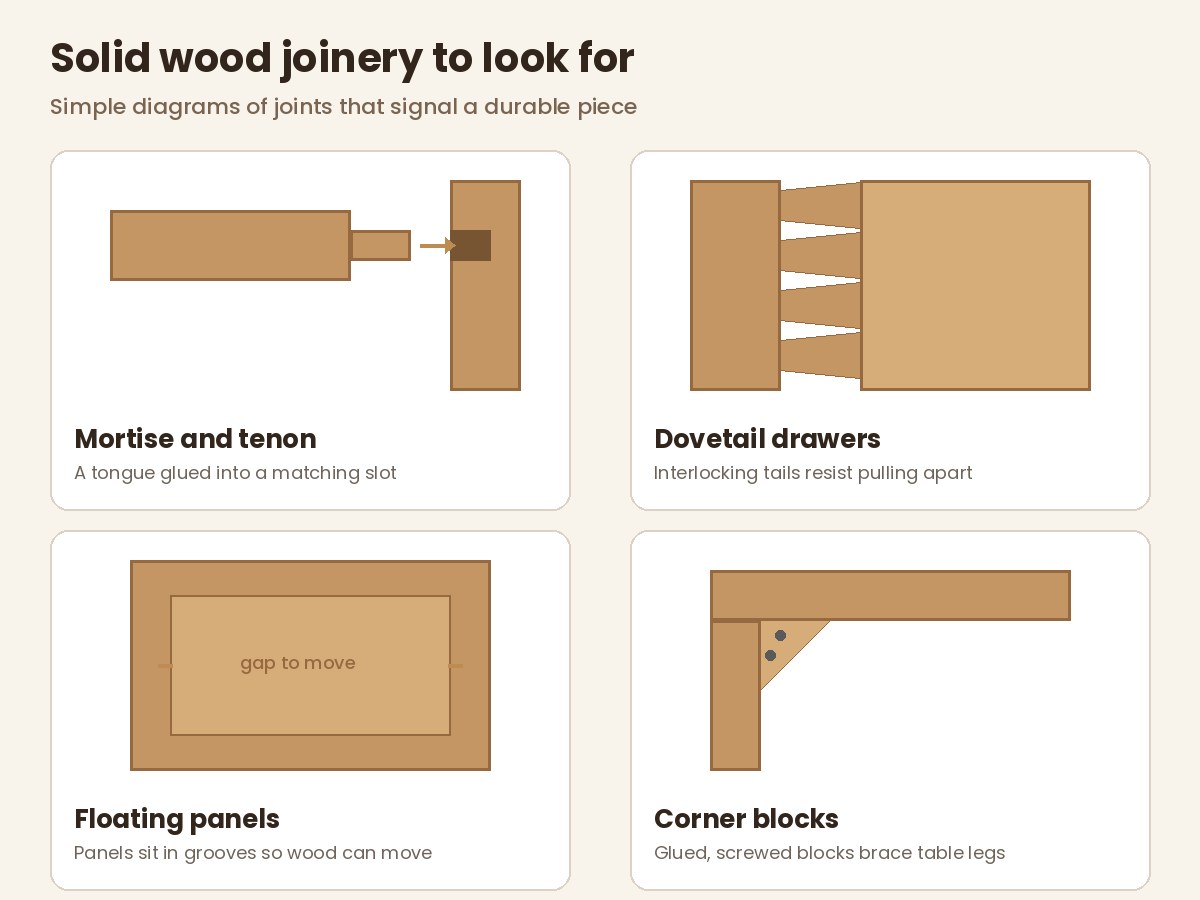
Two tables made from the same lumber can age completely differently. The difference is in how they were put together.
Joinery
Look for traditional joints such as mortise and tenon on chair and table frames, and dovetails on drawer corners. These interlocking joints give glue far more surface to grip, and they resist racking. Butt joints held only by staples or a couple of screws tend to loosen within a few years, especially on chairs that get leaned back on.
Allowance for movement
This is the detail most shoppers never think about, and it is the one that causes the most cracked tabletops. Wood swells and shrinks across its width as humidity changes, while barely changing along its length. Purdue University’s extension guide on the shrinking and swelling of wood and its effect on furniture explains why builders need to plan for this movement rather than fight it.
In practice, a well-built table attaches its top with clips, slotted screw holes or wooden “buttons” that let the top slide slightly. Solid panels in doors and cabinet sides should float in grooves instead of being glued tight. If a large solid top is screwed rigidly to the frame at every edge, sooner or later something has to give.
Finishes and what they mean for maintenance
The finish is the part of the piece you actually touch, and it decides how you will care for it. Most furniture falls into one of three groups:
- Film finishes (lacquer, varnish, polyurethane) form a hard layer on the surface. They protect well against spills and need very little beyond gentle cleaning.
- Penetrating oil finishes (tung, linseed, hardwax oils) soak into the wood and leave a natural, matte feel. They are easy to spot-repair but need reapplying every so often.
- Wax over oil or shellac is common on antiques and some handmade pieces. It looks lovely but is sensitive to heat and water.
Not sure what is on an older piece? A drop of water that beads on the surface usually means an intact film finish; water that quickly darkens the wood points to a thin or worn oil finish.
Solid wood furniture care, day to day
Most damage to good furniture is not dramatic. It is the slow work of grit, heat, sunlight and dry winter air. A few simple habits handle nearly all of it.
Dust and clean gently
Dust with a soft, slightly damp microfiber cloth, following the grain. Dry dust is mildly abrasive and, over time, dulls a finish. For sticky spots, use a cloth barely dampened with water and a drop of mild dish soap, then dry immediately. Skip all-purpose sprays, vinegar mixes and anything containing ammonia or bleach, which can cloud or soften finishes.
Be careful with polish
Silicone-based aerosol polishes give a quick shine but build up over the years and can make future refinishing much harder. For film-finished pieces, clean is usually enough. For oiled pieces, use the maintenance oil the maker recommends. For waxed pieces, a thin coat of paste wax once or twice a year is plenty.
Protect the surface
- Use coasters, trivets and placemats. Heat and moisture cause the familiar white rings in many finishes.
- Lift objects instead of dragging them across the top.
- Put felt pads under lamps, vases and decorative bowls.
- Wipe up spills right away, blotting rather than rubbing.
Managing humidity, heat and light
Wood slowly settles to a moisture content that matches the surrounding air. Oregon State University Extension’s guide to wood and moisture notes that wood for heated interiors is typically dried to around 7 percent moisture content, which corresponds to fairly moderate indoor humidity.
Problems start when the air swings to extremes. A heated home in a cold winter can drop well below 30 percent relative humidity, and that is when joints open, tops check and drawers rattle. Humid summers can then swell the same pieces until drawers stick.
- Aim for a steady middle ground. Somewhere around 35 to 55 percent relative humidity suits most furniture. A cheap hygrometer will tell you where you stand.
- Use a humidifier in winter if your readings regularly fall into the 20s, and a dehumidifier or air conditioning in muggy months.
- Keep pieces away from heat sources. Radiators, baseboard heaters, fireplaces and heating vents dry one side of a piece faster than the other.
- Manage sunlight. UV light fades walnut, darkens cherry and breaks down finishes. Sheer curtains, UV film on windows or simply rotating accessories now and then helps the color stay even.
If you are building or renovating, it is worth raising humidity control early. Our article on questions to consider with custom home builders in Toronto is a good starting point for those early planning conversations, and a whole-home humidifier belongs on the list.
Fixing small problems before they grow
Most minor issues don’t need a workshop.
- White water rings are often trapped moisture in the top layer of finish. Gentle warmth from a hair dryer on low, kept moving, sometimes clears them. Fresh rings respond best.
- Light scratches on oiled pieces can usually be rubbed out with a little of the original oil on a soft pad. On film finishes, a touch-up marker in a matching tone hides minor marks.
- Small dents in bare or oiled wood can sometimes be raised by placing a damp cloth over the spot and pressing briefly with a warm iron. Test on a hidden area first and avoid this on veneer.
- Loose chair joints should be fixed early. A wobbly joint wears itself out quickly. Re-gluing with fresh wood glue after removing old glue is far easier than repairing a broken tenon later.
For deep gouges, lifting veneer or a finish worn through to bare wood, call a furniture restorer. Professional refinishing usually costs less than replacing a quality piece, and it keeps the character you paid for.
Buying checklist for pieces that last
Before you hand over your card, run through a short list:
- Confirm the species and which parts are solid versus veneered.
- Pick a hardness that suits the room and the people using it.
- Check joinery on drawers, legs and chair frames.
- Look for how the top is attached and whether panels can float.
- Ask what finish was used and how the maker recommends caring for it.
- Think about where it will live: near a sunny window, a vent or a busy entryway.
- Consider how it pairs with the room’s hard surfaces. If you are redoing a kitchen, our guide to quartz countertop installation details looks at the details that shape a kitchen’s finished look, which is useful context when you are matching wood tones nearby.
The long view
Solid wood furniture care is less about products and more about habits. Buy pieces that were built to move with the seasons, keep the air in your home reasonably steady, and clean with a light touch. Do those three things and that table or dresser will pick up a gentle patina instead of cracks and wobbles, and it may well end up being the piece someone else inherits.
About The Author